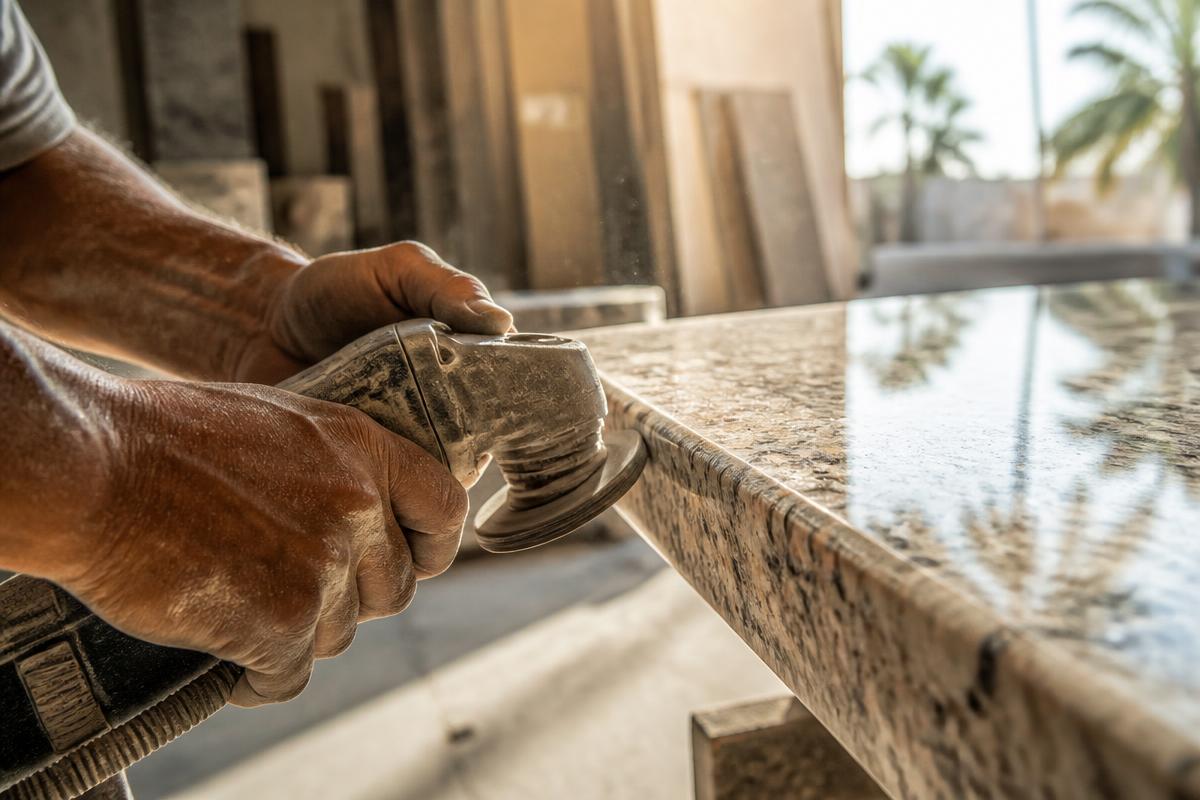
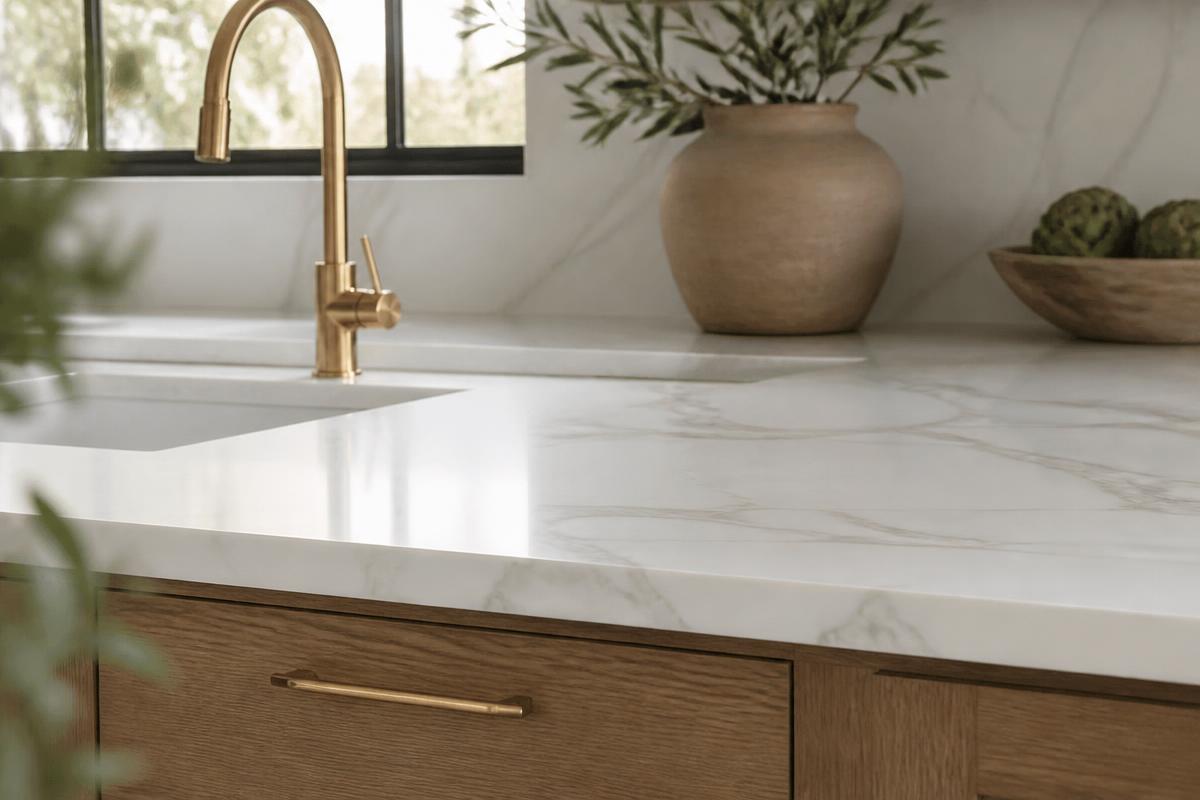
Caring for stone countertops in a Florida home
Everyday cleaning, what sealing does and does not do, and the few habits that matter more here than elsewhere.
Affordable Granite Florida · Updated August 28, 2026
Short answer
How do I look after a stone countertop?
Wipe spills when they happen, clean with warm water and a pH-neutral cleaner, keep acids off natural stone, and use a trivet and a cutting board. That covers almost everything. Sealing matters for natural stone; engineered quartz does not need it.
Everyday cleaning
Warm water, a soft cloth and a pH-neutral cleaner handle daily cleaning on all four of the surfaces we fabricate. What causes trouble is the cupboard under the sink: many general-purpose sprays, descalers and bathroom cleaners are acidic or abrasive, and on natural stone they can dull the polish or strip sealer. If a label does not say it is safe for natural stone, it is safer to assume it is not.
- Blot spills rather than spreading them, especially wine, citrus and oil
- Skip vinegar, lemon, bleach and anything abrasive on natural stone
- Avoid scouring pads; a soft cloth does the work
- Use a cutting board — for the knives as much as for the stone
What sealing actually does
Sealer slows liquid soaking into porous stone, which buys you time to wipe a spill before it becomes a stain. It is not a shield. It does not stop marble from etching, because etching is an acid reacting with the stone itself rather than something absorbing into it, and it does not make a surface heatproof.
Engineered quartz is non-porous and is not sealed at all. If someone recommends sealing a quartz countertop, that is a good moment to ask why.
Heat, sun and humidity
Heat is the one worth a habit. Natural stone tolerates it better than engineered quartz, whose resin can mark or discolor under a pan taken straight off the burner. A trivet costs nothing and removes the question entirely.
Direct sun matters more here than in most places. Long exposure can affect the resin in engineered quartz, and manufacturers differ on what they recommend for sunlit and outdoor installations — worth confirming for the specific line before it is cut, particularly for an outdoor kitchen or a run under a large window.
Humidity itself does little to a finished countertop. It matters more for what sits around it: cabinetry and the seal where the surface meets a wall or a sink are where moisture finds a way in, so a wipe rather than standing water is the habit that pays off.
The short version
- Warm water and a pH-neutral cleaner, every day
- A trivet under anything hot
- A cutting board, always
- Wipe spills rather than leaving them to sit
- Test natural stone with water now and then, and reseal when it stops beading
Keep exploring
Related questions
- Can I use disinfecting wipes on my countertop?
- Check the label. Many contain acids or solvents that are fine on laminate and hard on natural stone. Warm water with a pH-neutral cleaner is the safer default.
- My marble already has dull spots. Can they be fixed?
- Etching can often be improved by refinishing the affected area, though how well depends on the stone and the finish. Send us a photograph and we will tell you honestly what is realistic.
- Does quartz need sealing?
- No. Engineered quartz is non-porous, so there is nothing for a sealer to do.
Your room, measured properly
Ready to turn the guide into a plan?
Share a few photos and rough dimensions. We will help narrow the choices, then confirm the project after an on-site measurement.
Request an estimate